Anthropic Launches Claude Personal Finance Beta for US Subscribers
Anthropic has introduced a beta version of Claude Personal Finance, allowing US subscribers on Pro, Max, and Ultra plans to link bank accounts via Plaid. The feature offers read-only access to spending analysis, bill tracking, and visualization tools. While Claude cannot move funds, it processes sensitive financial data, raising privacy considerations for users integrating AI into personal finance management.
Key points
- Anthropic, an AI research company, is rolling out a beta feature called Claude Personal Finance for US subscribers on Pro, Max, and Ultra tiers.
- Users can link up to 16 US bank, credit card, and investment accounts through Plaid, granting the AI read-only access to balances, credit limits, and up to two years of transaction history.
- The tool analyzes spending patterns, tracks upcoming bills, flags duplicate charges, and generates customizable charts and dashboards without moving or managing user funds.
- Anthropic ensures data privacy by stating that Hub chats are not used for training and that conversations with linked accounts remain separate from Claude’s shared memory.
- The service operates without advertisements or sponsored financial product recommendations, though Anthropic warns users that the AI may make errors and should verify critical figures with their banks.
AI Meets Personal Finance
Anthropic has officially launched a beta version of Claude Personal Finance, a new feature designed to integrate artificial intelligence into personal money management. The rollout is currently available exclusively to subscribers in the United States who hold Pro, Max, or Ultra plans on the Claude platform. This development marks a significant expansion of the AI assistant's capabilities beyond general conversation and coding, moving into the sensitive domain of personal financial data analysis.
The core functionality of the Personal Finance feature relies on secure connections through Plaid, a widely used financial data network. Users can link up to 16 different US bank accounts, credit cards, and investment accounts. Through this integration, Claude gains read-only access to a comprehensive view of the user's financial life. This includes current balances, credit limits, and up to two years of historical transaction data. The read-only nature of the access is a critical security distinction; Claude cannot transfer funds, manage accounts, or make investment decisions on behalf of the user.
Data Privacy and Security Measures
Given the sensitivity of the data involved, Anthropic has outlined specific protocols to protect user information. The company emphasizes that users do not need to share their banking passwords with the AI assistant. Instead, authentication occurs directly with the bank through Plaid. To further safeguard privacy, Anthropic states that conversations conducted within the Personal Finance Hub are not used to train Claude’s underlying models. Additionally, chats involving linked financial accounts are kept separate from Claude’s shared memory, ensuring that financial insights do not bleed into general interactions.
Despite these safeguards, the feature does expose sensitive details. Authorized connections allow Claude to view account balances, credit limits, and detailed transaction histories. Anthropic acknowledges that this level of access involves sensitive information and advises users to exercise caution. The company explicitly warns that Claude can make mistakes in its analysis. Consequently, users are encouraged to verify important figures and decisions with their respective banks rather than relying solely on the AI’s output.
Features and Limitations
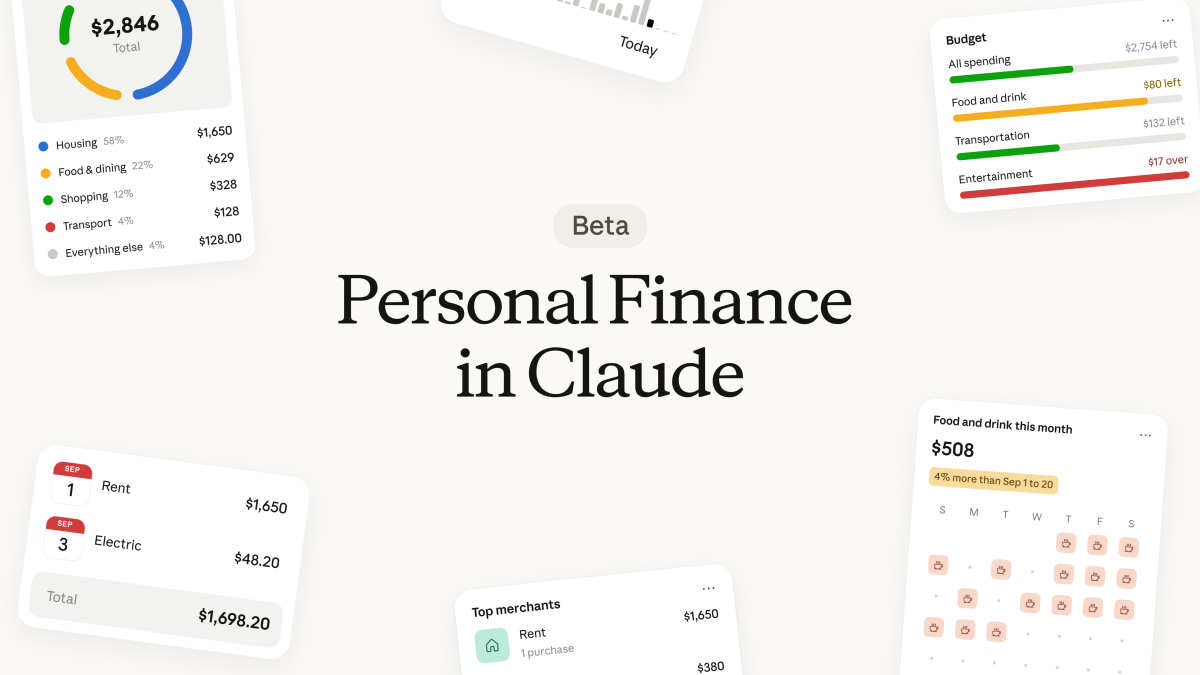
The Personal Finance beta offers a suite of analytical tools designed to simplify financial oversight. Users can ask Claude where their money went each month, identify creeping subscription costs, and spot duplicate charges or unusual fees. The AI can break down expenses into categories, compare spending across different months, and calculate remaining budget before payday. For visualization, Claude can generate customizable charts, calendars, and dashboards based on the linked data.
However, the feature has specific limitations. For investment, loan, and card accounts, Claude reads only balances and credit limits, rather than full transaction details for all account types. The service is also distinct from traditional financial products; it does not offer credit cards, loans, or savings accounts. Furthermore, there are no advertisements or sponsored financial product recommendations within the feature, aiming to maintain a neutral analytical stance.
Market Context and Future Implications
The launch of Claude Personal Finance places Anthropic in direct competition with other tech giants exploring AI-driven financial tools. By offering a read-only, ad-free analysis tool, Anthropic attempts to balance utility with privacy concerns that often plague free financial apps. The beta status indicates that Anthropic is still refining the feature, likely based on user feedback and performance data. As AI models become more integrated into daily life, the ability to accurately interpret and visualize complex financial data could become a standard expectation for premium AI subscriptions. The success of this beta will likely influence how other AI developers approach the intersection of machine learning and personal finance, particularly regarding data handling and user trust.
Key takeaways
- Anthropic is testing a Personal Finance beta for US Pro, Max, and Ultra subscribers.
- The tool links up to 16 US bank and card accounts via Plaid for read-only access.
- Users can analyze spending, track bills, and view visual dashboards without funds moving.
- Data is not used for training, and chats are isolated from shared memory.
- The service is ad-free but warns users to verify AI-generated financial figures.
Sources
The WireByte editorial team synthesises technology news from multiple primary sources, verifies the facts, and links every source. Articles are produced with AI assistance and reviewed under our editorial policy.